
Commercial Wind Power
Discover Renewable Energy Solutions for a Greener Future
About Resource Consents
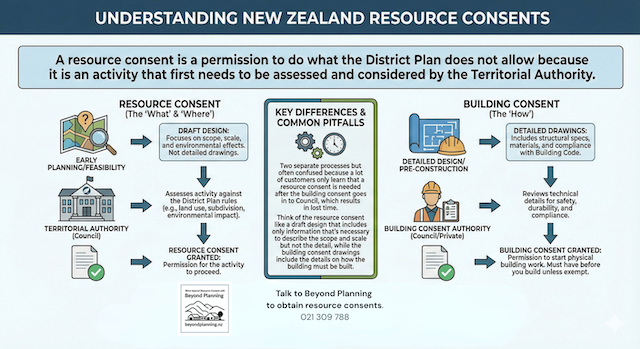
A resource consent is a permission to do something that the District Plan does not automatically allow. It is needed when an activity must first be assessed and approved by the Territorial Authority (the Council).
If the Council tells you that you need a resource consent, talk to Beyond Planning. Because we specialise in obtaining resource consents.
Beyond Planning is all about solutions but we are not afraid of unpacking the risks so that you can make good decisions. Experience teaches that Planning done well is more about respect than strategy. Sure there are a number of ways to get the result but we find treating people well, works actually works better. Which does not mean it is easy because experience matters.
Alex Wakefield is a Full Member of the New Zealand Planning Institute (NZPI) / Te Kōkiringa Taumata which is the professional body for planners, resource management practitioners, and related professionals in New Zealand. Full Member since 2003.
Different to Building Consents
A resource consent is different from a building consent. A building consent is needed to carry out building work (unless the work is exempt) and focuses on how the building will be constructed to achieve compliance with the Building Code. Also the work must pass inspections to allow passing each step through to completion.
You usually apply for resource consent before you prepare detailed building drawings.
- Think of the resource consent as a concept or draft design: it shows the scope and scale of what you want to do, but not all the construction details.
- The building consent drawings then provide the detailed information on how the building will be built.
These are two separate processes, but they are often confused. Many people only discover that a resource consent is required after they have already applied for a building consent, which can cause unnecessary delay and cost from redrawing and changing plans.
-
Licensed Building Practitioners (LBPs) are construction professionals who have been assessed by the government (MBIE) as competent to protect a residential building’s structure and weathertightness. If your project requires a Building Consent, you are almost certainly legally required to engage an LBP. It is vital that your LBP is fully aware of the Resource Consent which is another reason to obtain the Resource Consent before the Buiding Consent or at the least ensure that your LBP has the resource consent conditions, onsite during construction. It is vital that your LBP understands the specific conditions attached to your Resource Consent—such as height restrictions, earthworks limits, or boundary setbacks. They must ensure these conditions are strictly complied with during construction to avoid legal enforcement or work stoppages. Most Resource Consents start with “Condition 1”, which simply means: You must build exactly what is shown on the approved plans. The consequence of the building consent and resource consent drawings not matching (e.g., a deck that is too high), could mean that you have to apply for a “Variation of Conditions.” This is a new application to Council that costs extra time and money.